Friday, 23 October 2020

First Catch Your Beetroot

This is not a recipe for pickled beetroot. This is an experiment in making pickled beetroot based on a recipe for pickled beetroot.

First catch your beetroot
Washed, topped and tailed, we had about a kilo.
We simmered this very gently for an hour.
Meanwhile, we toasted about 4tsp of mixed pickling spice.
We added a mixture of red wine vinegar and pickling vinegar, because that's what we had. Total 700mg. Both have the 6% strength, which is necessary to preserve the beetroot.
We peeled the hot roots over a bowl of cold water - to make them handleable.
Then chopped the beetroot small enough to fit the jars. The jars and lids were washed and sterilised in a 'cool' oven. We filled the jars, leaving a space so that all the veg will be covered in vinegar and still with enough room for an air gap. Then we added a teaspoon of rocksalt.
Finally we filled the jars with the hot spiced vinegar and screwed the lids on.
The lids are of the 'tamper proof' type, that pop reassuringly to a concave shape as the jars cool.
Now we have to leave them alone for a couple of weeks.
Then eat.
If it tastes okay, put labels on and call it a recipe.


Thursday, 22 October 2020

Remembrance

Unbelievably, a year has passed since Pippy died.  

What is one to do?  The World keeps its orbit, seasons turn, and we have little choice but to turn with it, too.  Strangely, air still enters my lungs, blood still pumps around my body, and the mundanity of ordinary existence pushes us along, as unstoppable as the whole spinning World.  All I can do is mark the passing of time after time has stopped.  
So, anniversaries, significant, trivial, public and private, are marked.  I trundle on, like a midnight workman laying traffic cones from the back of a slow-moving lorry.  I drop another cone and watch it recede, my back to the future.  
A year of cones is in view and each one is distinct, for the time-being: our first Christmas without her, her birthday come and gone, our wedding day photos reviewed again, familiar, put away, but now infinitely precious.  Maybe habit will inure me, but I doubt it. And I know, for as long as my truck rolls on, there will always be new cones to drop.


Tuesday, 20 October 2020

Appearances

My neighbour, Bridget, loves this time of year, when the leaves start to turn: all those autumn colours.  But when John Keats spoke of 
Season of mists and mellow fruitfulness, 
Close bosom-friend of the maturing sun, 
I don't think he was contemplating his rhubarb patch.  I mean, face it: have you ever seen such a flat and depressing sight in a garden?
I took this picture on Saturday 17 October, as the anniversary of Pippy's death drew close.  Feeling flat already, I didn't need this.  The veg plot looks like it has given up.  Which indeed it has, in a manner of thinking; the season of growth is over.  

But I must remind myself that appearances are deceptive.  According to one neighbour (who is old enough to know) the rhubarb patch is over sixty years old.  Really, it's just resting, drawing it's energy into the succulent roots.  Until the days grow warm again, it bides its time. As I must do, we all must do.  Who would have thought that there is wisdom in a flacid rhubarb plant?

And still, I got a few apples from the Cox tree (for non-natives, this is a variety called Cox's orange pippin. It's sweet and sharp - like an orange. A pippin is an apple grown from a pip.)
I made a pie.
The skin is often scabby and mottled, but, like these were, beautiful inside.  Nature's admonishment to shallow people, ha ha.

Oh, alright then, John. Lift us up.

To Autumn

Season of mists and mellow fruitfulness,
  Close bosom-friend of the maturing sun;
Conspiring with him how to load and bless
  With fruit the vines that round the thatch-eves run;
To bend with apples the moss'd cottage-trees,
  And fill all fruit with ripeness to the core;
    To swell the gourd, and plump the hazel shells
  With a sweet kernel; to set budding more,
And still more, later flowers for the bees,
Until they think warm days will never cease,
    For summer has o'er-brimm'd their clammy cells.

Who hath not seen thee oft amid thy store?
  Sometimes whoever seeks abroad may find
Thee sitting careless on a granary floor,
  Thy hair soft-lifted by the winnowing wind;
Or on a half-reap'd furrow sound asleep,
  Drowsed with the fume of poppies, while thy hook
    Spares the next swath and all its twined flowers:
And sometimes like a gleaner thou dost keep
  Steady thy laden head across a brook;
  Or by a cider-press, with patient look,
    Thou watchest the last oozings, hours by hours.

Where are the songs of Spring? Ay, where are they?
  Think not of them, thou hast thy music too,--
While barred clouds bloom the soft-dying day,
  And touch the stubble-plains with rosy hue;
Then in a wailful choir the small gnats mourn
  Among the river sallows, borne aloft
    Or sinking as the light wind lives or dies;
And full-grown lambs loud bleat from hilly bourn;
  Hedge-crickets sing; and now with treble soft
  The redbreast whistles from a garden-croft,
    And gathering swallows twitter in the skies.


Friday, 25 September 2020

Kippered

I kipperized the neighbourhood this afternoon by burning the last bits of the old shed.  Seemed like a good idea at the time...
...but it got very smoky with all that semi-rotten wet wood.

Sunday, 20 September 2020

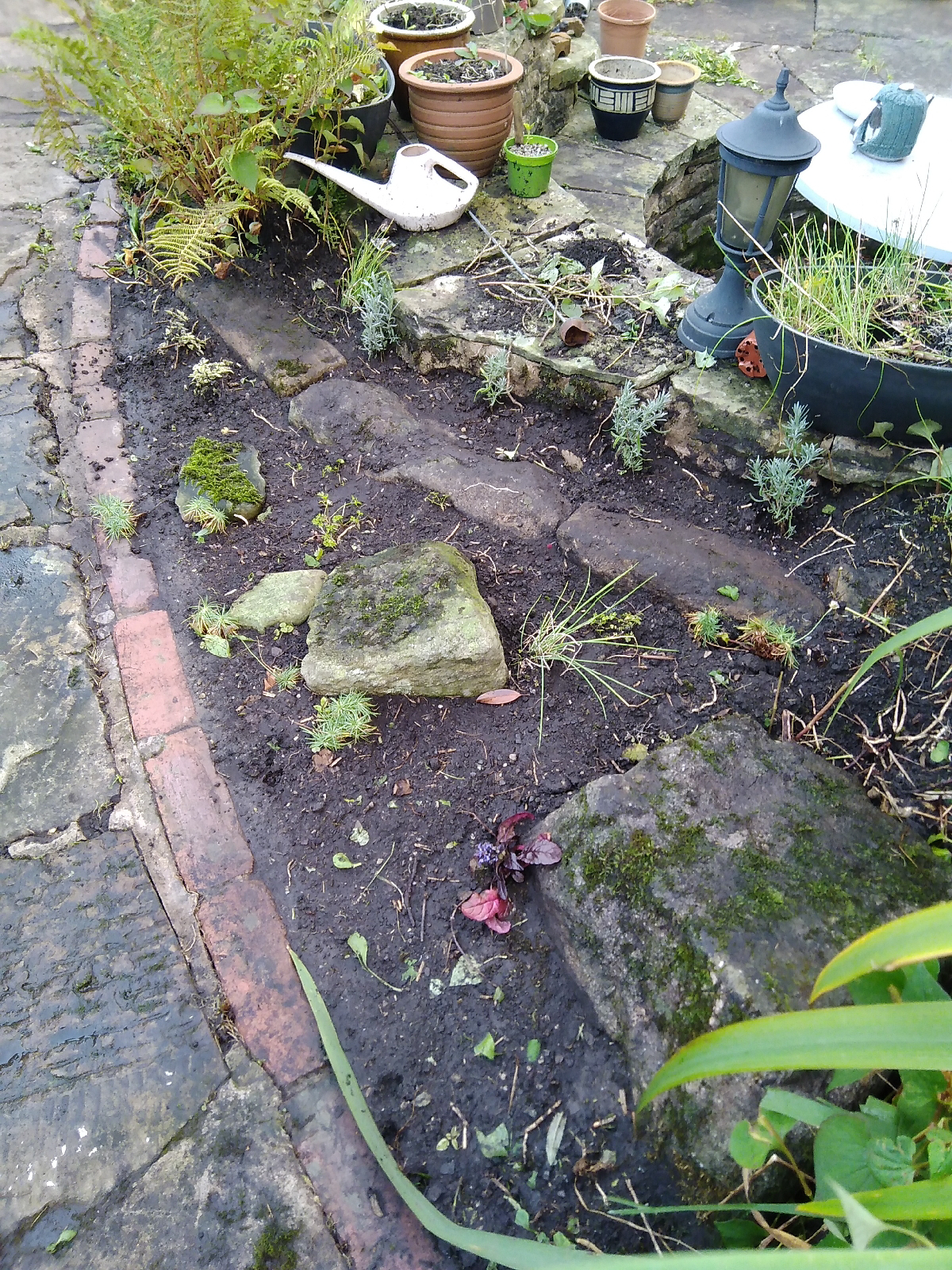
Restituted Rockery

Much overgrown lemon balm and chameleon plant removed, replanted with heather, variegated ajuga, and bits and bobs, including herbs from various pots, using my traditional planting technique of 'push it in and see what grows'.
The last photo in particular is not very prepossessing, but just you wait!

Low Down and Bertie

Have you ever smelled a bee? Well I have.  
Genie and I had two goes at restoring a very overgrown rockery this weekend.  I started by weeding around a hylotelephium sieboldii, which a rather large (big enough to have a name, but not a national insurance number) bumble bee was taking great interest in, probably because it didn't have to spell hylotelephium sieboldii.  

Anyway, disturbed, the bee took off, circled once in the manner of a professional navigator taking bearings on the Sun, and flew across my face, giving a pleasing ear-to-ear stereophonic effect, complete with Doppler shift.  I got a distinct whiff of honey!  I could hardly believe my nose. But it did it again a few minutes later.  "You've been at the juice, mate," I thought. But whether that was directed at the bee or myself, I'm not sure.

Hylotelephium sieboldii is indigenous to Japan, but has found a home as an introduced species in the Baltic States where, presumably, there are a lot of happy bees and bemused botanists.   This is it (thank you, Genie, for the photo):

Since its name is such a mouthful, I'll call it 'hi-lo', and the bee I've called 'Bertie'. 🐝

Friday, 11 September 2020

Onions Assemble!

Having left the onions to cure for about three weeks, the outer skins have browned and the leaves dried, so we made two onion strings.  The sizes were very variable and none were very big in this variety.  Still, it's satisfying to have them hanging up, ready for the pot.  More onions next year I think.  Here's Genie stringing along: